Friday, 30 November 2012

Analysis of opening credits - Miss H

What are opening credits?

Opening credits are shown at the very begining of a motion picture, television programme, or a video game. They list the most important members of the production (Major actors) and the crew, the closing credits list an extensive cast and production crew.
Opening credits may or may not be accompanied by music and usually can be shown in the form of text on can be shown on either: a blank screen, static pictures, or a top of action in the show.
There is a correct term for where opening credits are built into a seperate sequence of their own, the correct term for this is a title sequence. For example: James bond and Pink Panther title sequences.

What is the importance of opening credits?

The main title sequence or the opening credits of a movie can be considered the most important piece in a film. Other than trailers and marketing elements, they are the first images the audience sees when the lights go down. The credits outline the filmmaker's intentions and set up the expectations of those watching.

Se7en Opening Credits Analysis.


Se7en analysis:
While watching the 'se7ev' opening credits, it looked very confusing but interesting. In the beginning of the opening scene we would see lots of different camera shots also showing close ups, the audience can hardly see whats going on clearly which made the audience confused but they are still interested in what is going on. The first credit is the production company title, followed by the film name, then the big names and then finally the job roles. The low key lighting used in the scene helps to create confusion withing the audience as the scenes are less clear. The audience is able to see who appears and who creates the film from the information presented, the use of generic conventions of a thriller annotate what message the director is trying to put across. 


 Typography:
Typography is the size, colour, order and style of the font used in the opening credits. For example in 'seven' when the production company title appears, its quite small, has an edgy thriller font and it is also in white so it stands out from the dark background and sort of spooks the audience.

By looking at the typography of 'Saw's production name, we can see that there is barbed wire around a needle, this can suggest to the audience that the film will involve some sort of weapon in the film or something involving someone getting tortured. Also the name 'Twisted' also suggest the film is going to be very explicit and it suggests that the film has 'twisted' scenes in it. The bottom of the font shows a bit of shadow aswell, this can show that there is a dark side to the film and there is an element of supprise to it as you cannot always see what is going to happen.


Character representation - Miss H & G


Character Representation.


Main Character
Name: Hidden identitity
Age: 20
Gender: Male
Race: White british.    
Purpose of the narrative: The stalkers purpose is to find this girl he is obsessed with, he will not stop until he finds and catches this girl and he will make sure nothing will get in his way. He stalks to girl and sends her text messages to try and scare her.
How will the character appeal to the audience?: We think that the audience will not like this character because of his appeal of fear, the audience may hate this character while othey may think otherwise, although their opinions may changed by the way we represent him. We are hoping that the relationship the audience creates with this character is mainly a hate relationship to help us prove this point we have chosen for the stalker to wear black which symbolizes problems or evil (which the character is).

Female victim character.
Name: Dipika Sharma.
Age:16
Gender: Female
Race: Indian  
Purpose of this narrative: The victims purpose is to get along with her life and live a normal ordinary life a teenager would live, Dipika is that victim that is hunted down without her realizing, she has been receiving threatening text messages but she decides to ignore it as she thinks it is a joke being played from one of her friends, she doesn't realise how serious the text messages are until she walks back from her friends house through a forest and looks behind her to find the stalker following her, she then eventually gets grabbed and taken by the stalker.
How will the character appeal to the audience?: We think that the relationship built between the audience and the victim will be a strong sympathy relationship, this is evident from the victims facial expressions. As the victim begins to cry, we are hoping to have the audience placing their lives in the victims position which will help us create a sympathy effect.


The Victims Friend.
Name: Ayesha Ali
Age: 16   
Race: Asian British
Purpose of the narrative: There is no certain narrative for this character to be played, apart from being the victims friend. In our thriller opening Ayesha will be Dipikas friend, and one day after school Dipika will be going to Ayesha's house to collect some books. Once Dipika has collected the books and is on her way home but see's the stalker, Dipika tries to hide from the stalker and rings up Ayesha hoping she will pick up, but she doesn't.
How will the character appeal to the audience?: We don't think that the relationship between the audience and this character will hardly be created or noticeable as this character does not play an important role compared to the other characters.


Group Story Boards - Miss G

Group Storyboards. - Lauren, Ayesha & Dipika.

Storyboards.
Introduction: We had planned out a story board as a group to make it more easy for ourselfs when filming. As we were filming we would relate back to the storyboards to ensure we had not missed out on any scenes or camera shots, iconography etc. the storyboard. We are glad we had created our story board because it helped us have a background image of how our filming would hopefully turn out to look like.
In this storyboard Lauren had planned out the ideas for the opening scene, as a group we were glad that Lauren had chosen to plan out the opening scene as she was full of ideas and all her ideas were related to a expected thriller movie, but Lauren had made the ideas her own and had contributed them to the group.  The storyboard shows the scenes that we are going to use at the beginning of our thriller film. The stalker is sitting at a desk wearing a black hoody and gloves. This is conventional because the colour black connotes death and it helps conceal the identity of the stalker. We decided that we are going to use low-key lighting because it creates strong, bold shadows on the walls making it seem more mysterious and creepy. One of the camera shots is going to show the stalker writing a diary. The words will highlight threat for the victim showing the audience he has a plan to hurt her. The second camera shot shows the stalker cutting his hand with a knife and dripping the blood on the pages he just wrote on. This is conventional because the iconography is a generic weapon often used in thriller films. We plan to use fake blood which helps make the scene appear more realistic. Another camera shot we are going to use is the stalker lighting a match and burning a picture of his victim. This is effecting because it shows the audience straight away who the victim is. The fire symbolizes danger which is a generic theme in thrillers.Each scene is only going to be a few seconds long as we are using fast-editing. We are going to jumble up the scenes whilst playing loud non-diegetic music to build suspense. We decided this because we believed that because we are using fast editing, the non-diegetic sound would be made to match the speed of the film. It will get louder the quicker the film gets making the audience even more anxious.

Me, Lauren and Dipika as a group had made our individual ideas and had put them into one for this scene. We had joined together Laurens idea of the settings and sound, my idea of the iconography and Dipikas idea for the narrative, and the remaining sections we had all created as a group.
The second storyboard shows the victim being tied up in a dark room where the stalker had kidnapped her. We decided that we want to use low-key lighting because we thought it would help hide the background in the room more making the audience question the location. We also used it because it creates shadows which is conventional to the thriller genre. The camera will start of on a close up on her and gradually zoom out revealing that she is tied up. The iconography we plan to use is rope and duck tape. This is used to stop her speaking/yelling for help and tie her up so that she cannot escape. We plan to use different angles such as high angle, low angle when filming the victim wake up and look around the room. We are going to use straight cut, slow editing in this scene to emphasize the disorientation of the victim when she wake up and because it creates a level of anxiety for the audience. At the end of the scene with the girl waking up the camera is going to zoom in on the victims eye and dissolve into a flashback. The film is then going to show what happened the previous day and how the victim got herself in that predicament. The next scene is going to be the victim walking to her friends house. we are using high key lighting to make it appear like an ordinary day. The victim is going to wear a white jumper to connote her innocence. We are going to do a number of different camera shots such as zoom in/out low angles, long shot to make the film more tense.

 For the third storyboard, i had looked at the different types of camera angles that could be used to create as much tension as possible within the audience, keeping them in their seats. I had thought of the idea of placing the camera at a certain angle with a loud non digetic sound of the stalkers feet walking pass on a road along with the victim creating an enigma.
This storyboard is showing what happened in the flashback. The victim is walking to her friends house to collect some homework. We are going to film her walking towards the house and the two characters exchanging conversation. Whilst the victim is walking to the house we are going to use camera shots such as low angles to show the stalker following her. The camera shot will show the black boots of the stalker. The low angle is conventional to the thriller genre because it hides the identity of the stalker creating an enigma. We are also going to use point of view shot showing the stalker watching the victim from behind. In these scenes we plan to use non-diegetic sound because the deep tone will help build suspense. We are also going to use straight cut editing to show continuity through our thriller film. Once we use the scene where to two characters are talking to each other we are going to use diegetic such as the ringing of the door bell of the conversation. When the friend goes to collect the homework the victim is going to receive a text message from a unknown number. We are going to use birds eye view to show the message.

The final storyboard was created as a group, the final scene as shown as above was one of our most liked scenes throughout our opening. There was allot of excitement within the group while coming up with the ideas for the final scene, but as a group, joining our ideas together creating one was one our favorite decisions made.
In the storyboard it shows the final scene where the stalker finally kidnaps the victim. It is going to be set in a forest because it is a generic location in thriller and because it highlights the fact that it is an isolated location and no one will be able to hear the victim scream. We are going natural lighting because it starts of light but graudally gets dark. The stalker is going to be following the victim when you hear diegetic sound if a twig snap. This make the victim look behind where she notices the stalker standing behind her. She screams and begins to run. To make it more effective we are going to use a hand held camera shot. This helps emphasis the chaotic situation and help the audience see it from the victims point of view. Eventually the stalker catches the girl and covers her mouth so she cant call for help. The camera will then zoom back in onto her eye to show that the flashback has ended and she is back in the dark room.

Thursday, 29 November 2012

Planning the Production - Miss G

Planning the production.


Task one
Production role post:
Research and define the main roles of the following within a film production

Camera operator:
A camera operator or cameraman is a professional operator of a film or video camera. In film-making, the leading camera operator is usually called a cinematography, while a camera operator in a video production may be known as a television camera operator, video camera operator, or video graph-er, depending on the context and technology involved, usually operating a professional video camera.

Actors:
An actor communicates a character and/or situations to an audience through speech, body language and movement. This usually involves interpreting the work of a writer under the instruction and support of a director, although some work may require the actor to devise a character or improvise the reactions of a character to a situation.
Work varies enormously, from live stage performances of the classics and community theatre to soap operas, radio work and film parts. An actor's role may also involve education, training or therapy, as well as entertainment.
 Sound technician:
Sound technicians are required to assemble, operate and maintain the technical equipment used to record, amplify, enhance, mix or reproduce sound.
They identify the sound requirements for a given task or situation and perform the appropriate actions to produce this sound. Sound technicians of different types are required in a range of industries including film, broadcasting (radio or television), live performance (theatre, music, dance), advertising and audio recordings.

Editors:
The film editor works with the raw footage, selecting shots and combining them into sequences to create a finished motion picture. Film editing is described as an art or skill, the only art that is unique to cinema, separating filmmaking from other art forms that preceded it, although there are close parallels to the editing process in other art forms like poetry or novel writing. Film editing is often referred to as the "invisible art" because when it is well-practiced, the viewer can become so engaged that he or she is not even aware of the editor's work.

Film Directors:
A film director is a person who directs the actors and film crew in filming. They control dramatic aspects, while guiding the technical crew and actors.
 

Location Manager: 
The location manager is responsible for the finding and securing locations to be used and coordinating the logistics involved for the production to successfully complete its necessary work. They are also the face of the production to the community and responsible for addressing the issues that may arise due to the production's impact on the community.

Storyboard Organiser:  
A storyboard manager organizes and manages timelines to ensure work is completed on time. They plan the shots and camera angles that are going to be filmed and provides an overview plot of the story-line.

The link for where i have found most of these definitions are from the following source:
http://www.bbc.co.uk/schools/studentlife/careersandchoices/dreamjobs/mediaandentertainment/camera_operator.shtml

Task two:
As a group decide on which role each group will be taking and why?  

The roles each person in the group is going to play:
Camera Operator (Lauren, Dipika Ayesha)
Actor (Lauren, Dipika, Ayesha)
Editor (Lauren, Dipika, Ayesha)
Location Manager (Lauren and Ayesha)
Sound Technician (Lauren)
Storyboard Manager (Dipika)
Film Director (Ayesha)


The roles we have chosen for each person in the group to play is because we as a team discussed who we would think the suitable person for that particular job would be and who would get the best results. We have chosen for us three to be the camera operators as for most scenes we will have our individual ideas for which camera shot will be suitable for each scenes. We had applied the same rule for our preliminary task and we were all as a team happy with the results, so we will be taking forward this rule and use the same technique when we film our thriller opening. I (Ayesha) have been chosen to take on the role of being the film director as i believe and so do the group believe that i have been creating ideas about each individual  scene, the team had commented on the fact that i am well organised and am good with directing. Lauren was chosen to be the sound technician as we believe she has the most experience with the sound files, so she would be the most reliable source for sound. The storyboard manager is Dipika as she is most aware of the sspecific scenes and angles that we planned to use.


Wednesday, 28 November 2012

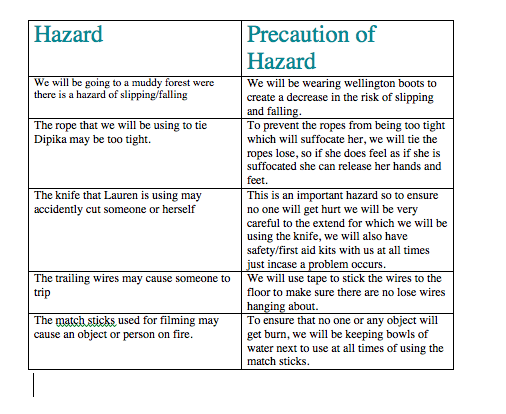
Risk Assessment - Miss G

In the table above, there is a list of possible hazards whilst filming our thriller opening. I have then written how we can take precautions in order to prevent these hazards for happening. I produced this table using Microsoft word and as a group we will use this as a guideline to make sure we are all safe and unharmed.
It is essential to consider the risks before film so we are aware of what could possibly happen and we can be careful avoiding these hazards. The risk assessment will assist my group when filming our thriller opening because we will take precautions such as buying gaffer tape and moving sharp objects aside.

Planning editing styles - Miss G

Planning editing styles.                                             

Editing
Video editing is the process of manipulating and rearranging video shots to create a new work, editing is usually considered to be one part of the post production process - other post-production tasks include titling, colour correction, sound mixing, etc.
Many people use the term editing to describe all their post-production work, especially in non-professional situation, editing involves:


  • Rearranging, adding and/or removing sections of video clips and/or audio clips
  • Applying colour correction, filters and other enhancements
  • Creating transitions between clips

Why is editing important?
The reason to why editing is important is because it prevents miscommunication between scenes. 
Editing is an important aspect in the process of film production. Generally, editing is done to provide continuity to a film. Editing is the part of post production of film making. Good editing can make a bad production look good and bad editing can turn a good production into bad, which reinforces why editing is so important. 

What types of editing styles will you include in your thriller & why? (3 or 4 different styles)
The types of editing styles i will be using followed with the reasons are:


  • Fast editing - Four our opening scene of our thriller we will be using the editing style 'fast editing', the reason to this is because it will convey a lot of information very quickly we have also used this technique as it is conventional to a thriller as it causes chaos, which catches the audience's attention. We will try to use the fast editing technique to bring attention the non-verbal actions of the speaking character
  • Match on action- For one of our scenes we have used the editing 'match on action' for when one of our characters are walking through the door and the camera has shown this, the reason to why we have chosen this is because it shows two different points of views so that the audience gets an understanding of both but so that they don't get confused with the narrative
  • Intercutting- We have used this shot for our opening scene for our thriller opening. The opening scene is first on the girl being trapped and then 'intercuts' to how it all began. This is conventional to a thriller as it keeps the audience is suspense as they are eager to find out what has happened and how the girl had been trapped in the first place.
  • Point of view- We have used this shot in our final scene for when we have shown the innocent girl walking in a forest but as she begins to run, the camera is being hand held (point of view) to show the audience her point of view. This is conventional to a thriller as it creates a relationship between the audience and the character as they can imagine and view the victims point of view, this shot is also conventional as the victims are always the one's running away.


Sunday, 25 November 2012

Narrative theory

Narrative theory.

What is a Narrative theory?
A narrative theory is the way in which a story is told in both fictional and non-fictional media texts.


Vladmir Propp's Narrative theory
. Propp has analysed 100 folk tales which he then discovered that all of the evident characters could be categorised into 8 broad types of didifferent character which were the following:

1.
The Villain - Who struggles against the hero.
2. The Dispatcher - The character who informs the hero on lack and sends him on his quest.
3. The (magical) Helper - Who helps the hero during the quest.
4. The Princess/Prize - Hero deserves to marry her, but cannot throughout the film because of the villain, often the quest is ended with the Hero and the Princess getting married.
5. Her Father - Gives Hero task and identifies False Hero, Propp noted that the Princess and the Father cannot be clearly distinguished.
6. The Donor - Prepares the Hero
7. The Hero or Victim/ Seeker Hero - Reacts to the donor and gets married to the Princess
8. False Hero - In order to marry the Princess, he takes credit for the Heroes actions to impress her.


Even though Propp has clearly stated the different categories of characters that were found in tales, Propp failed to state that these has to apply to every seperate character; the villain could also be the father etc. Looking at Propp's theory when a character has been identified correctly within a story, it is easily predictable to what the characters roles will be throughout the movie as each character has a sphere of action. 


Tzvetan Todorov's Theory.

Tzvetan Todorov

We have tried to incorporate his theories into our production also , to ensure that our thriller keeps the viewer entertained and on the edge of their seats. The following describes how Todorovs theory is used within film narrative.
Equilibrium:
The equilibrium is normally shown in the first few scenes of a film and creates a sense of normality for both the viewer and the main character.
A Disruption Of That Order:
After the state of normality in Todorovs theory , he describes a disruption of that normality in which an event occurs that both changes and propels the narrative forward. In our story , this event occurs when our main character receives a text from her phone. The text message says that the stalker can see her This immediately disrupts any normality and helps evolve the plot into a story that can grip the audience for an entire films length.
An attempt to restore equilibrium:
Once a disruption has been established, our main character needs to attempt to restore order to the narrative. Our plot follows our character as she walks through a mysterious setting (forest) to where she is kidnapped and caught by the stalker.  

A New Equilibrium:
Todorov stated that although movies tend to end with a restored equilibrium , it is often different to the equilibrium seen at the start of a production. This is because the evolution of the stories plot means that the same equilibrium seen at the start of a film is unable to be sustained once again.


 Aristotle's Theory

In his poetics, Aristotle considered the plot the most important element of drama—more important than character, for example. A plot must have, Aristotle says, a beginning, a middle, and an end, and the events of the plot must causally relate to one another as being either necessary or probable
Of the utmost importance to Aristotle is the plot's ability to arouse emotion in the psyche of the audience. In tragedy the appropriate emotions are fear and pity emotions which he considers in his rhetoric.  

Which ones apply to the group narrative? 

        The theory that applies to my group theory is aristotle. It links to his the theory because we have used common themes such as a stalker, antagonist/protagonist, and empathy/Sympathy. In our thriller opening our characters are going to consist of a stalker and a victim. The victim gets kidnapped and it goes into a flash back to reveal what had happened. Aristotle included a beginning, a middle, and an end, for our thriller opening we have also create a beginning, middle and an end and all of our events relate closely to one another.